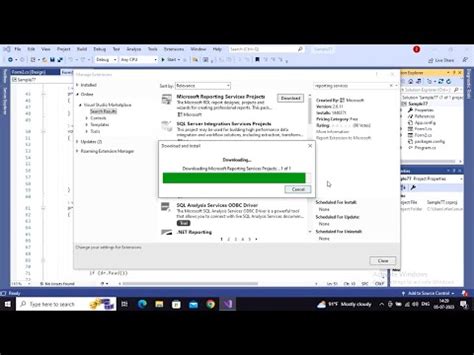
To start Report Designer
- Open SQL Server Data Tools.
- On the File menu, point to New, and then click Project.
- In the Project Types list, click Business Intelligence Projects.
- In the Templates list, click Report Server Project.
- Type a name and location for the project, or click Browse and select a location.
- Click OK.
To create a Reporting Server project
- In Visual Studio, open the File menu, point to New, and then choose Project.
- Under Project types, choose Business Intelligence Projects.
- Under Templates, choose Report Server Project.
- In the Name box, type a name for the project, and then choose OK.
We'll walk you through it, step-by-step.
- Step 1 - Make sure your computer is ready for Visual Studio.
- Step 2 - Download Visual Studio.
- Step 3 - Install the Visual Studio installer.
- Step 4 - Choose workloads.
- Step 5 - Choose individual components (Optional)
- Step 6 - Install language packs (Optional)
How to Create A Table Report Using Visual Studio Report Designer
- Create a report project.
- Set up a data connection.
- Define a query.
- Add a table data region.
- Format the report.
- Group and total fields.
- Preview the report.
- Optionally publish the report.
Generally, It is required to install sql server database with visual studio setup. Here are the steps to install sql server database with setup using custom action. 1. In Solution Explorer, select the project.
vsix extensions right from the explorer, with a right click.
- Install. Follow the instructions in the Marketplace, or run the following in the command palette: ext install fabiospampinato.vscode-install-vsix.
- Usage. Right click a .vsix file from the explorer and select Install Extension :
- Settings.
- Contributing.
- License.
Report Definition Language (RDL) is an XML representation of a SQL Server Reporting Services report definition. A report definition contains data retrieval and layout information for a report. RDL is composed of XML elements that match an XML grammar created for Reporting Services.
SQL Server Reporting Services (SSRS) is a data reporting platform from Microsoft. It is a part of Microsoft SQL services suite along with SSIS and SSAS. SSRS is used for generating server based reports in different formats and styles.
2 Answers
- Install SSDT for Visual Studio if you haven't already done so.
- Create a new project using the 'Report Server Project' template.
- Copy/move the .rdl file(s) you have into the folder for the newly created project (eg ..Visual Studio 2015ProjectsMy Report ProjectMy Report Project)
- Use the "Add Existing Item"
Create a report by using the Report tool
- In the Navigation Pane, click the table or query on which you want to base the report.
- On the Create tab, in the Reports group, click Report.
- For more about viewing and printing your report, see the section View, print, or send your report as an e-mail message.
Report Definition Language (RDL) is a standard proposed by Microsoft for defining reports. RDL is usually written using Visual Studio, although there are also third-party tools; it may also be created or edited by hand in a text editor.
To create a local report server database
- Start the Reporting Services Configuration Manager and connect to the report server instance for which you are creating the database.
- On the Database page, select Change Database.
- Select Create a new report server database, and then select Next.
Creating a Report
- Click View, then Reports.
- Reports Navigator is displayed.
- For the Master Report name, enter Departments.
- For the style, select Table.
- In the SQL text box, enter Select * from departments .
- Click Apply.
- The Departments report is added to the User Defined Reports tree.
Opening a Report File
- Open Microsoft Excel.
- Go to the OfficeWriter Designer tab and click Open Report.
- If your report defintion file was saved on a local or network drive, navigate to the folder containing the file, select it, click Open, and continue to Adding Fields to your report.
Install SSDT with Visual Studio 2019
- Launch the Visual Studio Installer.
- In the installer, select for the edition of Visual Studio that you want to add SSDT to, and then choose Modify.
- Select SQL Server Data Tools under Data storage and processing in the list of workloads.
Editions. Like SQL Server, SSRS comes in both Standard and Enterprise Editions. If your users already have SQL Server CALs, and you are using the Standard Edition of SSRS, then get the Server+CAL license of SQL Server for the SSRS server. There's no need for a CAL based license unless you really need one.
Certain Important Characteristics That Define SSRS:Showcases data-driven information in the form of formatted reports with a variety of maps, tabular reports, matrix reports, graphs, images, charts. It comes as a free version with SQL Server.
In Administrative Tools, open Services. Right-click SQL Server Reporting Services (MSSQLSERVER), SQL Server Reporting Services, or Power BI Report Server. Select Stop or Restart.
In this article
- Click Start > Administrative Tools > Services to open the Services management console.
- Right-click the SQL Server Reporting Services ([InstanceName]) service, and then click Restart.
To start Report Designer
- Open SQL Server Data Tools.
- On the File menu, point to New, and then click Project.
- In the Project Types list, click Business Intelligence Projects.
- In the Templates list, click Report Server Project.
- Type a name and location for the project, or click Browse and select a location.
- Click OK.
The version of an installed reporting services service can be found easily at the bottom of the page when you browse to . For the edition, you can check the system registry.
If you want the report server to use less memory, you can modify the RSReportServer.config file and add the element and value. Valid values range from 0 to maximum integer. This value is expressed in kilobytes.
Recommended content
- Install Reporting Services 2016 native mode report server - SQL Server Reporting Services (SSRS)
- Find the product key for SQL Server Reporting Services - SQL Server Reporting Services (SSRS)
- Create a report server database, Configuration Manager - SQL Server Reporting Services (SSRS)
To connect to a native mode report server
- If Object Explorer isn't already open it, select it from the View menu.
- Select Connect to view the list of server types, and then select Reporting Services.
- In the Connect to Server dialog box, enter the name of the report server instance.
- Select the Authentication type.
Pro – Pro plans cost $9.99 per user, per month. Premium – Power BI's Premium tier is $4,995 per month, per dedicated cloud compute and storage resource.
SQL Server 2019 Reporting Services is available for download from the Microsoft Download Center.
Obtain and Run the SSRS InstallerDownload the installer from the Microsoft Download Center here: Microsoft SQL Server 2019 Reporting Services. Run the SQLServerReportingServices.exe executable when the download is complete, and the first screen will open.
1. Navigate to Start → All Programs → Microsoft SQL Server 2008 R2 → Configuration Tools → Reporting Services Configuration Manager. 2. In the Reporting Services Configuration Connection dialog, make sure that your local report server instance (for example SQLExpess) is selected and click Connect.
SQL Server Reporting Services (SSRS) is a reporting software that allows you to produce formatted reports with tables in the form of data, graph, images, and charts. These reports are hosted on a server that can be executed any time using parameters defined by the users.
How to Open an SSRS RDL Report in Visual Studio 2017 and 2019
- You will see the file downloaded.
- You will see:
- Be sure to close any Visual Studio instances running.
- We can now create Report Server Projects in Visual Studio.
- In Visual Studio 2019:
- Once created, we see:
- From here, we can add or create RDL reports:
A common question that gets asked is if SQL Serve Express supports Reporting Services. Yes it does however you need to install the version Advanced Services which can be downloaded from here.