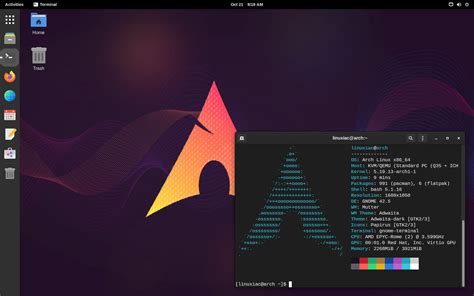
Arch is the clear winner. By providing a streamlined experience out of the box, Ubuntu sacrifices customization power. The Ubuntu developers work hard to make sure that everything included in a Ubuntu system is designed to work well with all the other components of the system.
ArchLinux gained “some” popularity after some people saw that it's really powerful distro and built other distros on top of it using that powerful system but at the same time trying to simplify user's life, some of these distros are : Manjaro Linux, Apricity OS, Antergos.
Most people recommend about 8 Gigs of RAM nowadays to have a smooth experience. But as most questions are related to Windows or macOS, it's quite hard to compare these requirements with something as lightweight and efficient as Arch Linux, or linux-based operating systems in general.
Arch isn't particularly speedy, they still build gigantic binaries like everyone else. There's got to be some difference in the software stack you're installing. But if Arch is faster than other distros (not at your difference level), it's because it's less "bloated" (as in you only have what you need/want).
Best Linux Distros for Beginners
- Ubuntu. If you've researched Linux on the internet, it's highly probable that you have come across Ubuntu.
- Linux Mint Cinnamon. For years, Linux Mint has been the number one Linux distribution on Distrowatch.
- Zorin OS. A majority of computer users are Windows users.
- Elementary OS.
Newbies whoever want to taste Arch Linux, i advise you to try with Arch Anywhere.
- 1) Check for updates.
- 2) Add New User and assign sudo privilege.
- 3) Enable Multilib repository.
- 4) Enable Yaourt Package Tool.
- 5) Enable packer Package Tool.
- 7) Install Web Browsers.
- 8) Update Latest & Nearest Mirror.
- 10) Install Flash player.
Arch Linux are difficult to set up because they are born without an installation bundler. They are a bit like the original Linux system with its source code. The installation is so complicated & unlike any other OS you have ever done. There is no graphical installer to install Arch.
Arch Linux is a rolling release and that eradicates the system update craze that users of other distro types go through. Also, every update is compatible with your system so there is no fear about which updates might break something and this makes Arch Linux one of the most stable and reliable distros ever.
Do you consider Arch Linux suitable for server environment? Its rolling release model and simplicity seems to be a good thing, because once you installed it, you do not need to reinstall like the release model from other distros. Although it is bleeding edge, Arch Linux uses the most recent STABLE version of software.
The Arch Build System allows you to compile and customize specific packages relatively easily, but if you want to set options across your entire system portage is more efficient. It depends what you want. If you want really fine-grained control, Gentoo is worth it.
In most cases Arch is less secure as it's a rolling release hence doesn't have as good of a testing period as a stable Debian release, which comes with a code freeze. Debian distributions have some preset configurations and most packages are downloaded to be installed rather than built from the code.
In summary, the steps look like this:
- Download the official current release of Arch Linux and boot into it.
- Download the script with curl.
- Load your preferred keymap with the command loadkeys [keymap] — for example loadkeys us.
- Edit the alis.
- Execute the script with ./alis.sh.
Completely safe. Has little to do with Arch Linux itself. AUR is a massive collection of add-on packages for new/other softwares not supported by Arch Linux. New users cannot easily use AUR anyway, and use of that is discouraged.
Arch Linux is lightweight, and simple. With Arch, you basically start with bare-bones Linux, which can boot into a CLI, has the basic stuff like Vi, grep, and these kind of basic Unix tools, that you'd have to install anyway, as well as a tool with which you can install packages.
Today we announce the release of Arch Linux -B. This is radically different from -A and is not compatible hence the 'Cease' notification.
Arch packages are more current than Debian Stable, being more comparable to the Debian Testing and Unstable branches, and has no fixed release schedule. Arch keeps patching to a minimum, thus avoiding problems that upstream are unable to review, whereas Debian patches its packages more liberally for a wider audience.
arch command is used to print the computer architecture. Arch command prints things such as “i386, i486, i586, alpha, arm, m68k, mips, sparc, x86_64, etc.
This said, you can imagine that the Arch iso, provides ~350mb for 32bit, and ~350mb for 64bit. The download of the basic packages, is just convienience if you have internet, so you have the latest packages for the base system, from which you may install a DE/WM of your choice.
systemd is a software suite that provides an array of system components for Linux operating systems. The name systemd adheres to the Unix convention of naming daemons by appending the letter d. It also plays on the term "System D", which refers to a person's ability to adapt quickly and improvise to solve problems.
- Ubuntu. One of the most popular distros for good reasons.
- Elementary OS. Probably the best looking distro in the world.
- Linux Mint. A strong option for those new to Linux.
- openSUSE. Primarily targeted at devs and sysadmins.
- CentOS. Offshoot of Enterprise version of Red Hat Linux.
- Arch Linux.
Arch Linux is such a GNU/Linux distribution, using GNU software like the Bash shell, the GNU coreutils, the GNU toolchain and numerous other utilities and libraries.
When was Arch Linux created?
Yes, arch Linux worth it if you like to learn how your system works. As the others said the Wiki is all you need for the installation. It should be pretty easy if you follow the guide and if you try to understand. pacman and aur repos are so useful, try it at least on a VM to see how it works.
It's a comment in /r/LinuxQuestions turned into meme to show superiority over Fedora users. A lot of users there feel that they're better than you because they compile everything from source and have more knowledge than you, a lowly noob.
Their guess for the total number of Linux users is about 88 million. So, if Ubuntu really has 40 million users and using the machine distribution ratio, there should be about 4.8 million Arch users, equal to about 5.5% of all Linux users.
Arch strives to stay bleeding edge, and typically offers the latest stable versions of most software. Arch also offers the Arch Linux User Repository (AUR), which contains more than 49,000 build scripts, for compiling installable packages from source using the Arch Linux makepkg application.
It is best to use the pacman package manager that comes along with Arch Linux, as it it's the most reliable tool for installing packages in Arch. Here are guides to installing rpm and deb packages on Arch Linux: RPM: rpm-file-on-arch-linux.