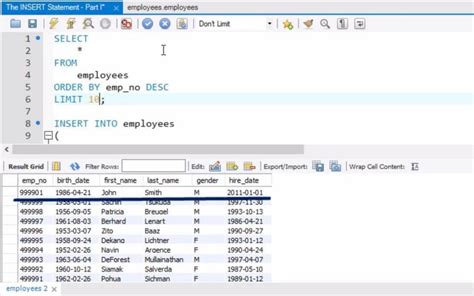
To insert a row into a table, you need to specify three things:
- First, the table, which you want to insert a new row, in the INSERT INTO clause.
- Second, a comma-separated list of columns in the table surrounded by parentheses.
- Third, a comma-separated list of values surrounded by parentheses in the VALUES clause.
INSERT INTO Syntax
It is possible to write the INSERT INTO statement in two ways. The first way specifies both the column names and the values to be inserted: INSERT INTO table_name (column1, column2, column3, )You use the WHERE clause for UPDATE queries. When you INSERT, you are assuming that the row doesn't exist. In MySQL, if you want to INSERT or UPDATE, you can use the REPLACE query with a WHERE clause. If the WHERE doesn't exist, it INSERTS, otherwise it UPDATES.
insert. When you insert something or someone, you put it into something else. You could insert yourself into a conversation, or you could insert a comma into the sentence you just wrote.
INSERT INTO Syntax
It is possible to write the INSERT INTO statement in two ways. The first way specifies both the column names and the values to be inserted: INSERT INTO table_name (column1, column2, column3, )SELECT INTO Syntax
SELECT column1, column2, column3, WHERE condition; The new table will be created with the column-names and types as defined in the old table. You can create new column names using the AS clause.There are two ways of using INSERT INTO statement for inserting rows: Only values: First method is to specify only the value of data to be inserted without the column names. INSERT INTO table_name VALUES (value1, value2, value3,…); table_name: name of the table.
INSERT INTO
SELECT copies data
from one table to another table.
INSERT INTO
SELECT requires that data types in source and target tables match.
The SQL INSERT INTO SELECT syntax
- INSERT INTO table-name (column-names)
- SELECT column-names.
- FROM table-name.
- WHERE condition.
To insert a row into a table, you need to specify three things:
- First, the table, which you want to insert a new row, in the INSERT INTO clause.
- Second, a comma-separated list of columns in the table surrounded by parentheses.
- Third, a comma-separated list of values surrounded by parentheses in the VALUES clause.
To add multiple rows to a table at once, you use the following form of the INSERT statement: INSERT INTO table_name (column_list) VALUES (value_list_1), (value_list_2), (value_list_n); In this syntax, instead of using a single list of values, you use multiple comma-separated lists of values for insertion.
SET DEFINE OFF removes SQL+'s special meaning for &, which is to turn a word into a variable. Apostrophe (=Single Quote): Replace all apostrophes with 2 apostrophes in your insert statements; they'll be added to the database as just one.
Before inserting the data, set the identity_insert option on for the table. You can set identity_insert on for only one table at a time in a database within a session. The insert statement lists each column, including the IDENTITY column, for which a value is specified.
How to View a Table in a SQL Server Database
- First, you'll need to open Enterprise Manager and expand the registered SQL Server.
- Expand Databases to see a list of databases on the server.
- Locate and expand the specific database containing the table you wish to view.
- Click on Tables, which will show all of the tables in the database in the pane to the right.
SET IDENTITY_INSERT Student ON; INSERT INTO Student VALUES('1','joedio','newyark',GETDATE()); SET IDENTITY_INSERT Student OFF; If you wants that SQL manage it self then default it set to IDENTITY_INSERT OFF and Auto increment is set, means on every insert the new value is assigned to that PK column.
Yes - SQL Server can perform basic addition, subtraction, multiplication and division. In addition, SQL Server can calculate SUM, COUNT, AVG, etc. For these type of calculations, check out SQL Server T-SQL Aggregate Functions.
The SQL COUNT() function returns the number of rows in a table satisfying the criteria specified in the WHERE clause. It sets the number of rows or non NULL column values. COUNT() returns 0 if there were no matching rows.
SQL Server DIFFERENCE() Function
The DIFFERENCE() function compares two SOUNDEX values, and returns an integer. The integer value indicates the match for the two SOUNDEX values, from 0 to 4. 0 indicates weak or no similarity between the SOUNDEX values.The SQL COUNT() function returns the number of rows in a table satisfying the criteria specified in the WHERE clause. It sets the number of rows or non NULL column values. COUNT() returns 0 if there were no matching rows. The above syntax is the general SQL 2003 ANSI standard syntax.
SELECT COUNT returns a count of the number of data values. SELECT SUM returns the sum of the data values. SELECT AVG returns the average of the data values.
Underscore Operator
The underscore character ( _ ) represents a single character to match a pattern from a word or string. More than one ( _ ) underscore characters can be used to match a pattern of multiple characters.Which SQL keyword is used to retrieve a maximum value? Explanation: The MAX() function returns the largest value of the selected column.
Difference between WHERE and HAVING clause in SQL? The main difference between WHERE and HAVING clause comes when used together with GROUP BY clause, In that case WHERE is used to filter rows before grouping and HAVING is used to exclude records after grouping.
SUM is used with a GROUP BY clause. The aggregate functions summarize the table data. Once the rows are divided into groups, the aggregate functions are applied in order to return just one value per group. It is better to identify each summary row by including the GROUP BY clause in the query resulst.